Cell: The Unit of Life

4.1 Prokaryotic Cells: Cell Envelope and its Modifications

Score: 0 / 27
Time: 00:00
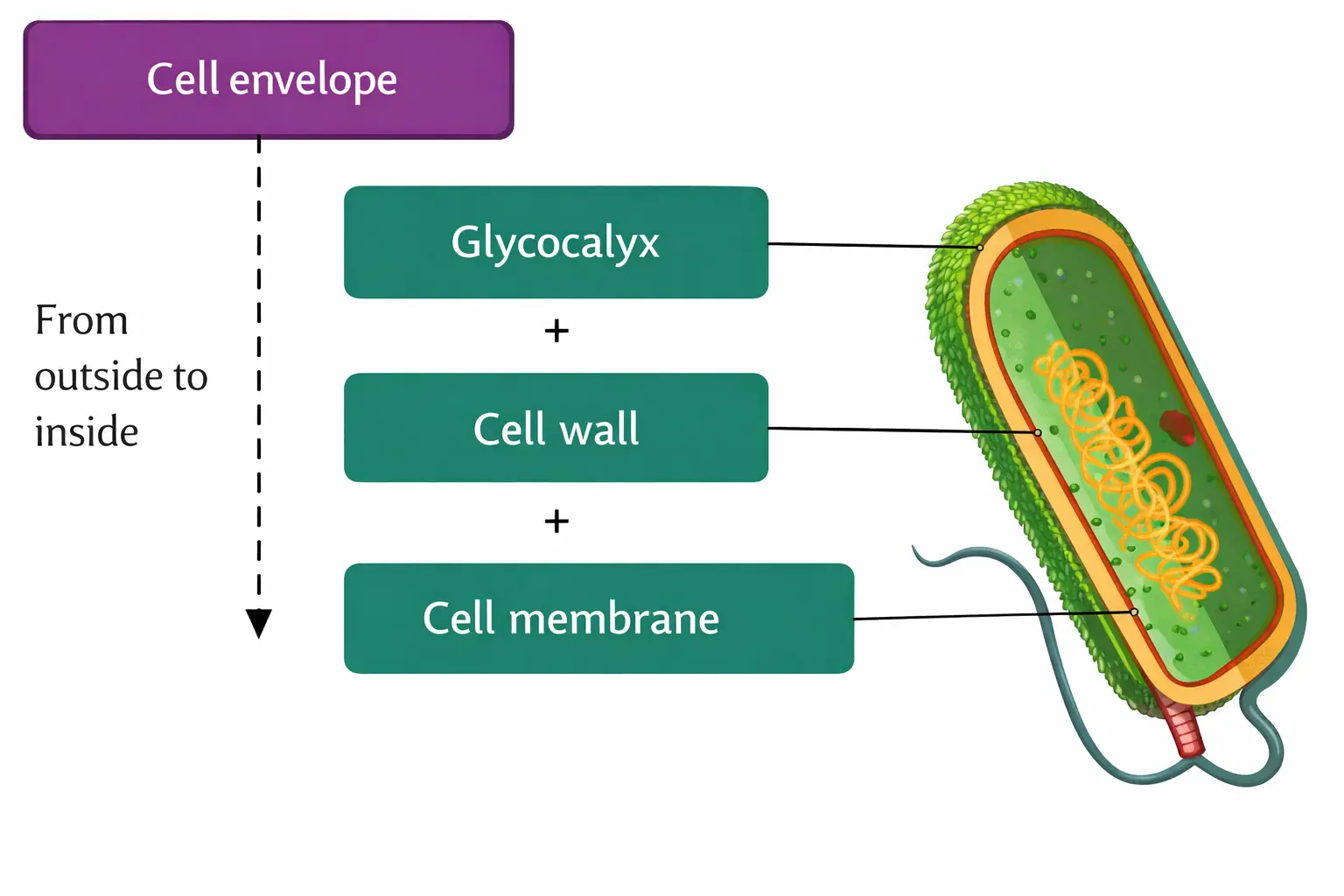
1. Most prokaryotic cells, particularly the bacterial cells, have a _____ ?

2. The cell envelope consists of a tightly bound three layered structure i.e., _____

3. Although each layer of the cell envelope performs distinct function, they act together as a _____

4. Bacteria can be classified into two groups on the basis of the differences in the _____

5. Bacteria can be classified into two groups based on differences in cell envelopes and their response to the staining procedure developed by _____

6. Bacteria can be classified into two groups based on their response to Gram staining: those that take up the Gram stain are _____ and those that do not are called _____.

7. Glycocalyx differs in _____ among different bacteria.

8. The glycocalyx in some bacteria is a loose sheath called _____, while in others it is thick and tough, called _____.

9. The plasma membrane is _____ in nature and interacts with the outside world.

10. The plasma membrane of prokaryotes is structurally similar to that of _____

11. A special membranous structure formed by extensions of the plasma membrane into the cell is called _____

12. Mesosome extensions in prokaryotic cells are in the form of _____

13. Mesosomes help in _____

14. Mesosomes also help in _____

15. In some prokaryotes like cyanobacteria, membranous extensions containing pigments are called _____

16. Bacterial cells may be _____

17. Motile bacterial cells have thin filamentous extensions from their cell wall called _____

18. Bacterial flagellum is composed of three parts, namely _____

19. In a bacterial flagellum, which part is the longest and extends from the cell surface to the outside?

20. Besides flagella, which surface structures are present in bacteria but do not play a role in motility?

21. Pili are elongated tubular structures made of a _____

22. What is the main function of pili in bacteria?

23. Some pili, known as adhesive pili, help in _____

24. Pili are _____ fimbriae.

25. Fimbriae in bacteria are _____

26. In some bacteria, fimbriae help in _____

27. Which statement correctly describes fimbriae and pili in bacteria?


© 2025 Maa99 — All Rights Reserved.