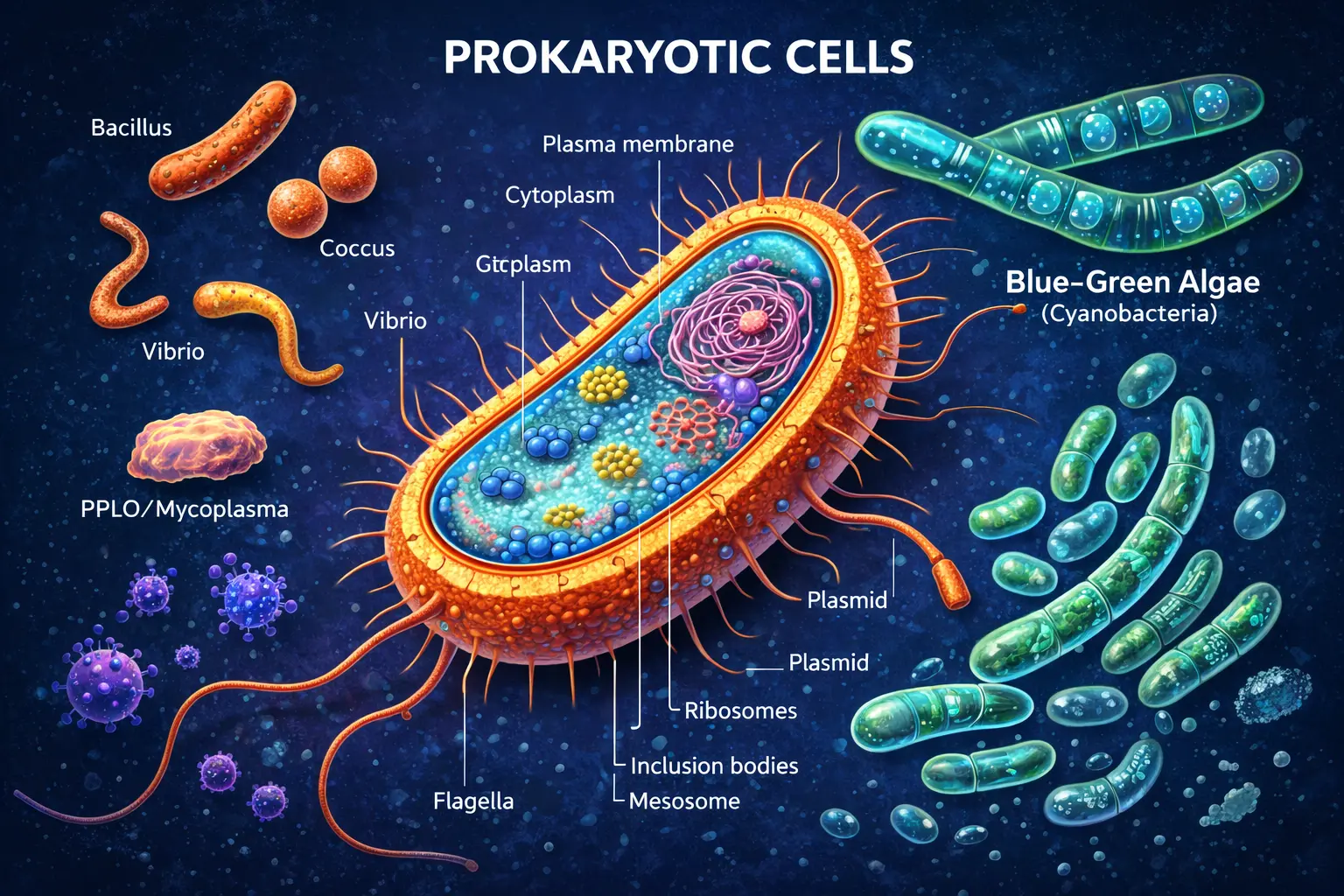
1. Prokaryotic cells are simple cells.<br>2. They lack membrane bound nucleus.<br>3. They include bacteria.<br>4. Blue-green algae are also prokaryotic.<br>5. Mycoplasma are smallest prokaryotes.<br>6. PPLO are similar organisms.<br>7. They have simple structure.<br>8. They lack membrane bound organelles.<br>9. They are primitive cells.<br>10. Thus, these organisms represent prokaryotes.
2. They are generally ____ than the eukaryotic cells.
Correct Answer: B
1. Prokaryotic cells are simple in structure.<br>2. They are smaller in size.<br>3. Compared to eukaryotic cells, they are tiny.<br>4. They reproduce quickly.<br>5. Their multiplication rate is high.<br>6. This helps rapid growth.<br>7. It is a key characteristic.<br>8. Seen in bacteria.<br>9. Important for survival.<br>10. Thus, they are smaller and multiply rapidly.
3. Prokaryotic may vary greatly in shape and size. The four basic shapes of bacteria are ____.
Correct Answer: B
1. Bacteria show variation in shape.<br>2. There are four main types.<br>3. Bacillus are rod-shaped.<br>4. Coccus are spherical.<br>5. Vibrio are comma-shaped.<br>6. Spirillum are spiral-shaped.<br>7. These shapes help classification.<br>8. It is important in microbiology.<br>9. Each shape has different features.<br>10. Thus, bacteria have four basic shapes.
4. The organisation of the prokaryotic cell is fundamentally ____ even though prokaryotes exhibit a wide variety of shapes and functions.
Correct Answer: B
1. Prokaryotic cells vary in shape.<br>2. They also vary in function.<br>3. However, their basic structure is same.<br>4. They have similar organization.<br>5. They lack membrane bound nucleus.<br>6. They have simple structure.<br>7. This similarity is fundamental.<br>8. It helps in classification.<br>9. It is a key concept.<br>10. Thus, their organization is similar.
5. All prokaryotes have a cell wall surrounding the cell membrane except in ____.
Correct Answer: B
1. Prokaryotes generally have a cell wall.<br>2. It surrounds the cell membrane.<br>3. It provides protection and support.<br>4. However, there is an exception.<br>5. Mycoplasma lacks a cell wall.<br>6. It has a flexible membrane instead.<br>7. This makes it unique.<br>8. It is the smallest prokaryote.<br>9. This feature helps identification.<br>10. Thus, mycoplasma lacks cell wall.
6. The semi-fluid matrix filling the cell is the ____.
Correct Answer: B
1. The cell contains internal material.<br>2. This material fills the cell.<br>3. It is fluid in nature.<br>4. It is called cytoplasm.<br>5. It supports organelles.<br>6. Many reactions occur in it.<br>7. It is present in all cells.<br>8. It occupies most of the cell.<br>9. It helps in cell activities.<br>10. Thus, cytoplasm is the fluid matrix.
7. Prokaryote is no well-defined ____.
Correct Answer: B
1. Prokaryotic cells are simple.<br>2. They lack membrane bound structures.<br>3. Their genetic material is not enclosed.<br>4. Hence, no true nucleus is present.<br>5. DNA is present in nucleoid region.<br>6. It is not membrane bound.<br>7. This is a key feature.<br>8. It distinguishes them from eukaryotes.<br>9. It shows simple organization.<br>10. Thus, no well-defined nucleus is present.
8. The genetic material in typical bacteria is basically ____.
Correct Answer: B
1. Bacteria are prokaryotic cells.<br>2. They lack a true nucleus.<br>3. Their DNA is not enclosed by membrane.<br>4. It is present in nucleoid region.<br>5. It is called naked DNA.<br>6. No nuclear membrane is present.<br>7. This is a key feature of prokaryotes.<br>8. It differentiates them from eukaryotes.<br>9. It shows simple organization.<br>10. Thus, genetic material is naked and not membrane bound.
9. In addition to the genomic DNA(the single chromosome/circular DNA), many bacteria have ____ outside the genomic DNA.
Correct Answer: B
1. Bacteria contain genomic DNA.<br>2. It is usually circular.<br>3. Apart from this, extra DNA may be present.<br>4. This DNA is small and circular.<br>5. It is called plasmid.<br>6. It lies outside the main DNA.<br>7. It carries additional genes.<br>8. It helps in survival.<br>9. It is common in bacteria.<br>10. Thus, bacteria have small circular DNA.
10. These smaller DNA are called ____.
Correct Answer: B
1. Bacteria have extra DNA apart from genomic DNA.<br>2. This DNA is small and circular.<br>3. It is present outside the main chromosome.<br>4. These are called plasmids.<br>5. Plasmids carry additional genes.<br>6. They help in survival.<br>7. They may provide resistance.<br>8. They are common in bacteria.<br>9. They replicate independently.<br>10. Thus, smaller DNA are called plasmids.
11. The plasmid DNA confers certain unique ____ characters to such bacteria.
Correct Answer: B
1. Plasmids are small circular DNA.<br>2. They are present in bacteria.<br>3. They carry extra genes.<br>4. These genes express certain traits.<br>5. Traits are observable characters.<br>6. These are called phenotypic characters.<br>7. Example: antibiotic resistance.<br>8. It helps bacteria survive.<br>9. It is a unique feature.<br>10. Thus, plasmids confer phenotypic characters.
12. Plasmids:One such character is resistance to ____.
Correct Answer: B
1. Plasmids carry extra genes.<br>2. These genes give special traits.<br>3. One important trait is resistance.<br>4. It helps bacteria survive drugs.<br>5. These drugs are antibiotics.<br>6. Bacteria become resistant.<br>7. This makes treatment difficult.<br>8. It is a major concern.<br>9. It spreads easily.<br>10. Thus, resistance is to antibiotics.
13. In higher classes you will learn that this plasmid DNA is used to monitor bacterial transformation with ____.
Correct Answer: B
1. Plasmids are small circular DNA.<br>2. They are used in genetic studies.<br>3. Scientists insert DNA into plasmids.<br>4. This DNA is called foreign DNA.<br>5. It helps in transformation of bacteria.<br>6. Bacteria take up this DNA.<br>7. It is used in biotechnology.<br>8. It helps in gene cloning.<br>9. It is an important technique.<br>10. Thus, plasmids are used with foreign DNA.
14. Nuclear membrane is found in ____.
Correct Answer: B
1. Nuclear membrane surrounds the nucleus.<br>2. It is a membrane bound structure.<br>3. Eukaryotic cells have a true nucleus.<br>4. This nucleus is enclosed by membrane.<br>5. Prokaryotes lack nuclear membrane.<br>6. Their DNA is not enclosed.<br>7. This is a key difference.<br>8. It helps in classification.<br>9. It is important in cell structure.<br>10. Thus, nuclear membrane is found in eukaryotes.
15. No organelles, like the ones in eukaryotes, are found in prokaryotic cells except for ____.
Correct Answer: B
1. Prokaryotic cells are simple cells.<br>2. They lack membrane bound organelles.<br>3. Organelles like mitochondria are absent.<br>4. Golgi bodies are also absent.<br>5. However, ribosomes are present.<br>6. Ribosomes are non-membrane bound.<br>7. They help in protein synthesis.<br>8. They are found in all cells.<br>9. This is an exception.<br>10. Thus, ribosomes are present in prokaryotes.
16. Prokaryotes have something unique in the form of ____.
Correct Answer: B
1. Prokaryotic cells are simple.<br>2. They lack membrane bound organelles.<br>3. However, they have special structures.<br>4. These are called inclusions.<br>5. Inclusions store nutrients.<br>6. They are not membrane bound.<br>7. They help in survival.<br>8. They are unique to prokaryotes.<br>9. They are found in cytoplasm.<br>10. Thus, prokaryotes have inclusions.
17. A specialised differentiated form of cell membrane called ____ is the characteristic of prokaryotes. They are essentially ____ of cell membrane.
Correct Answer: B
1. Prokaryotic cells have special structures.<br>2. One such structure is mesosome.<br>3. It is a form of cell membrane.<br>4. It is specialised and differentiated.<br>5. It is characteristic of prokaryotes.<br>6. Mesosomes are formed by folding of membrane.<br>7. These folds are called infoldings.<br>8. They increase surface area.<br>9. They help in cell functions.<br>10. Thus, mesosomes are infoldings of membrane.