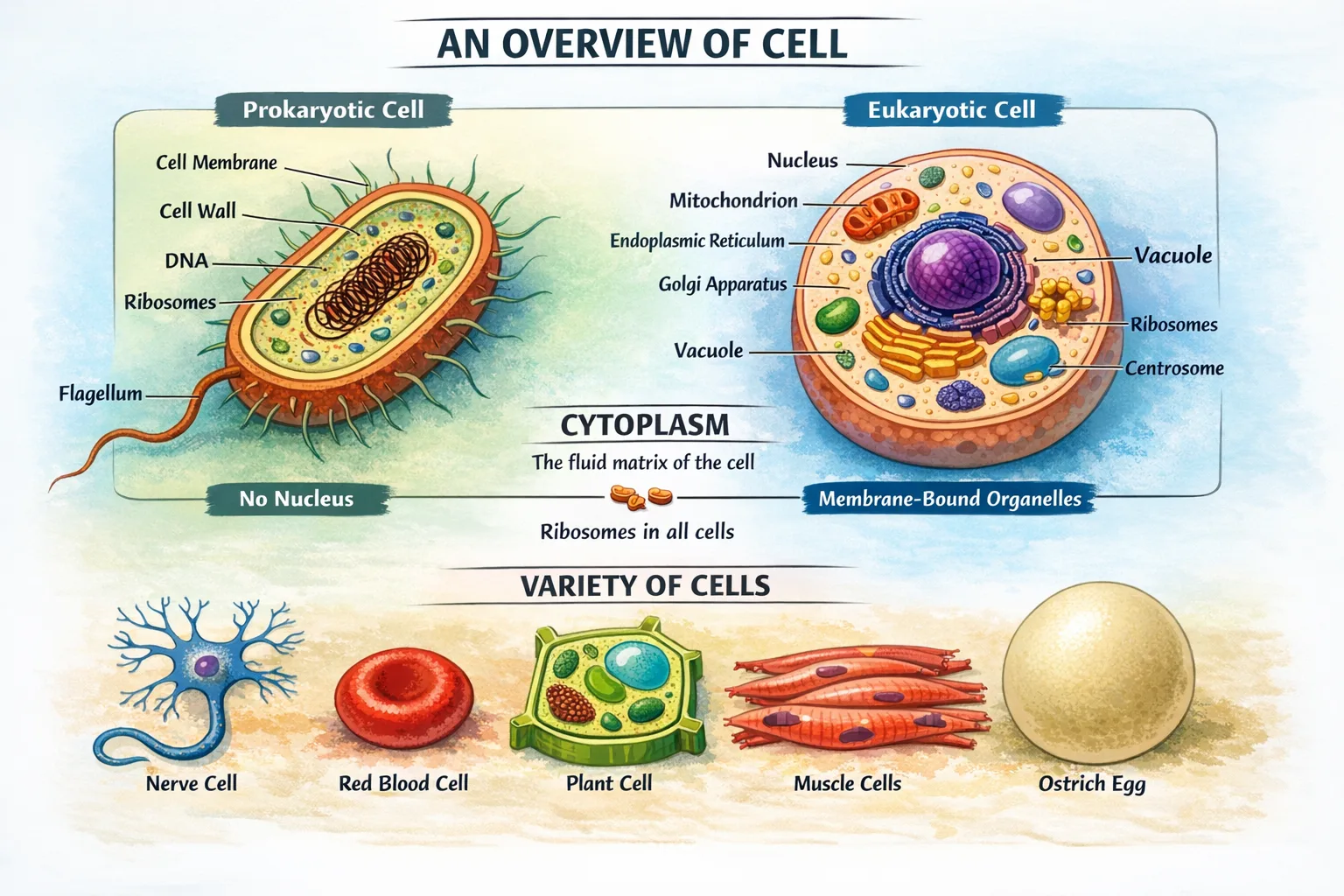
1. You have earlier observed cells in an onion peel and/or human cheek cells under the microscope. Let us recollect their structure. The onion cell which is a typical plant cell, has a ________ as its outer boundary and just within it is the cell membrane.
Correct Answer: B
1. Onion peel cells are plant cells.<br>2. Plant cells have an outer covering.<br>3. This outer boundary is the cell wall.<br>4. It is distinct and rigid.<br>5. It provides support and protection.<br>6. Inside it lies the cell membrane.<br>7. This is a typical plant cell structure.<br>8. It helps maintain shape.<br>9. It is absent in animal cells.<br>10. Thus, onion cell has a distinct cell wall.
2. The cells of the human cheek have an outer membrane as the ____ of the cell.
Correct Answer: B
1. Human cheek cells are animal cells.<br>2. Animal cells do not have a cell wall.<br>3. Their outer boundary is the cell membrane.<br>4. This membrane acts as a delimiting structure.<br>5. It separates cell contents from surroundings.<br>6. It controls entry and exit of substances.<br>7. It maintains cell integrity.<br>8. It is flexible in nature.<br>9. This is typical of animal cells.<br>10. Thus, outer membrane is the delimiting structure.
3. Inside each cell is a dense membrane bound structure called ____.
Correct Answer: B
1. Cells contain different organelles.<br>2. One important structure is the nucleus.<br>3. It is dense and membrane bound.<br>4. It controls cell activities.<br>5. It contains genetic material.<br>6. It is present inside the cell.<br>7. It is clearly visible under microscope.<br>8. It is essential for life.<br>9. It regulates functions.<br>10. Thus, nucleus is a dense membrane bound structure.
4. This nucleus contains the chromosomes which in turn contain the ____.
Correct Answer: B
1. The nucleus is present inside the cell.<br>2. It contains chromosomes.<br>3. Chromosomes carry genetic information.<br>4. This genetic material is DNA.<br>5. DNA controls inheritance.<br>6. It carries instructions for cell functions.<br>7. It is passed to next generation.<br>8. It is essential for life.<br>9. Without it, cells cannot function properly.<br>10. Thus, chromosomes contain genetic material DNA.
5. Cells that have membrane bound nuclei are called ____ whereas cells that ____ are prokaryotic.
Correct Answer: B
1. Cells are classified based on nucleus.<br>2. Some cells have membrane bound nucleus.<br>3. These are called eukaryotic cells.<br>4. They have organized structures.<br>5. Some cells lack membrane bound nucleus.<br>6. These are called prokaryotic cells.<br>7. They are simpler in structure.<br>8. This is a basic classification.<br>9. It applies to all organisms.<br>10. Thus, eukaryotic and prokaryotic differ by nucleus.
6. In both prokaryotic and eukaryotic cells, a ____ matrix called ____ occupies the volume of the cell.
Correct Answer: B
1. Cells contain internal material.<br>2. This material fills the cell.<br>3. It is semi-fluid in nature.<br>4. It is called cytoplasm.<br>5. It is present in all cells.<br>6. Both prokaryotic and eukaryotic cells have it.<br>7. It supports organelles.<br>8. Many reactions occur in it.<br>9. It occupies most of the cell volume.<br>10. Thus, cytoplasm is a semi-fluid matrix.
7. The ____ is the main arena of cellular activities in both the plant and animal cells.
Correct Answer: B
1. Cytoplasm is present inside the cell.<br>2. It is a semi-fluid matrix.<br>3. It contains various organelles.<br>4. Many metabolic reactions occur here.<br>5. It supports cellular functions.<br>6. It is present in both plant and animal cells.<br>7. It occupies most of the cell space.<br>8. It helps in transport within the cell.<br>9. It is essential for life processes.<br>10. Thus, cytoplasm is the main arena of activities.
8. Various chemical reactions occur in it to keep the cell in the ____.
Correct Answer: C
1. Cytoplasm is the site of many reactions.<br>2. These reactions are chemical in nature.<br>3. They include metabolism.<br>4. These reactions maintain life.<br>5. Without them, the cell cannot survive.<br>6. They keep the cell active.<br>7. This ensures proper functioning.<br>8. It supports growth and development.<br>9. It maintains internal balance.<br>10. Thus, reactions keep the cell in living state.
9. Besides the nucleus, the eukaryotic cells have other membrane bound distinct structures called ____.
Correct Answer: B
1. Eukaryotic cells are complex.<br>2. They contain membrane bound structures.<br>3. These are called organelles.<br>4. Examples include ER and Golgi complex.<br>5. Lysosomes and mitochondria are also organelles.<br>6. Microbodies and vacuoles are included.<br>7. Each organelle has specific function.<br>8. They help in cell activities.<br>9. They maintain organization.<br>10. Thus, these structures are called organelles.
10. The ____ cells lack such membrane bound organelles.
Correct Answer: B
1. Cells are classified into prokaryotic and eukaryotic.<br>2. Eukaryotic cells have membrane bound organelles.<br>3. Prokaryotic cells are simpler.<br>4. They do not have such organelles.<br>5. Their structure is less complex.<br>6. They lack a true nucleus.<br>7. Organelles like ER and mitochondria are absent.<br>8. This is a key difference.<br>9. It helps in classification.<br>10. Thus, prokaryotic cells lack membrane bound organelles.
11. ____ are non-membrane bound organelles found in all cells - both eukaryotic as well as prokaryotic.
Correct Answer: B
1. Ribosomes are small organelles.<br>2. They are not membrane bound.<br>3. They are present in all cells.<br>4. Found in both prokaryotic and eukaryotic cells.<br>5. They help in protein synthesis.<br>6. They may be free or attached to ER.<br>7. They are essential for cell function.<br>8. They are composed of RNA and proteins.<br>9. They are called protein factories.<br>10. Thus, ribosomes are non-membrane bound organelles.
12. Within the cell, ribosomes are found not only in the cytoplasm but also within the three organelles - ____.
Correct Answer: B
1. Ribosomes are present in all cells.<br>2. They are found freely in cytoplasm.<br>3. They are also attached to rough ER.<br>4. Ribosomes are present in mitochondria.<br>5. They are also found in chloroplasts of plants.<br>6. These organelles have their own ribosomes.<br>7. This helps in protein synthesis.<br>8. It supports organelle function.<br>9. Distribution of ribosomes is widespread.<br>10. Thus, ribosomes are found in cytoplasm, mitochondria, chloroplasts and rough ER.
13. Animal cells contain another non-membrane bound organelle called ____ which helps in cell division.
Correct Answer: B
1. Animal cells have various organelles.<br>2. Some are non-membrane bound.<br>3. Centrosome is one such organelle.<br>4. It is present in animal cells.<br>5. It helps in cell division.<br>6. It organizes spindle fibres.<br>7. These fibres help in chromosome movement.<br>8. It is important for mitosis.<br>9. It ensures proper division.<br>10. Thus, centrosome helps in cell division.
14. Cells differ greatly in ____.
Correct Answer: B
1. Cells are the basic units of life.<br>2. Different cells perform different functions.<br>3. Their size varies widely.<br>4. Their shape also differs.<br>5. Activities depend on function.<br>6. Example: nerve cells and muscle cells.<br>7. This variation helps specialization.<br>8. It improves efficiency.<br>9. It supports organism survival.<br>10. Thus, cells differ in size, shape and activities.
15. For example, ____ , the smallest cells, are only 0.3 µm in length while ____ could be 3 to 5 µm.
Correct Answer: B
1. Cells vary in size.<br>2. Some are very small.<br>3. Mycoplasmas are among the smallest cells.<br>4. They are about 0.3 µm in size.<br>5. Bacteria are larger than mycoplasma.<br>6. They range from 3 to 5 µm.<br>7. This shows variation in cell size.<br>8. Size depends on function and type.<br>9. It is an important concept.<br>10. Thus, mycoplasmas are smallest and bacteria are larger.
16. The largest isolated single cell is the egg of an ____.
Correct Answer: B
1. Cells vary in size.<br>2. Some cells are very large.<br>3. The egg is a single cell.<br>4. The ostrich egg is the largest single cell.<br>5. It is visible to the naked eye.<br>6. It contains all nutrients for development.<br>7. It supports embryo growth.<br>8. It is a classic example.<br>9. It shows size variation.<br>10. Thus, ostrich egg is the largest single cell.
17. Among multicellular organisms, human red blood cells are about ____ in diameter.
Correct Answer: B
1. Cells vary in size.<br>2. Human red blood cells are small.<br>3. They are also called erythrocytes.<br>4. Their size is about 7.0 µm.<br>5. This helps in easy movement in blood vessels.<br>6. Their shape is biconcave.<br>7. This increases surface area.<br>8. It helps in oxygen transport.<br>9. They lack nucleus.<br>10. Thus, RBCs are about 7.0 µm.
18. ____ cells are some of the longest cells.
Correct Answer: B
1. Cells vary in size and shape.<br>2. Some cells are very long.<br>3. Nerve cells are among the longest.<br>4. They are also called neurons.<br>5. They have long extensions.<br>6. These help in transmission of impulses.<br>7. They connect different parts of the body.<br>8. Their length supports communication.<br>9. They are specialized cells.<br>10. Thus, nerve cells are some of the longest.
19. Cells also vary greatly in their shape. They may be ____.
Correct Answer: B
1. Cells show variation in shape.<br>2. Shape depends on function.<br>3. Some cells are disc-like.<br>4. Some are polygonal or columnar.<br>5. Others are cuboid in shape.<br>6. Some are thread-like.<br>7. Some may be irregular.<br>8. This variation helps specialization.<br>9. It improves efficiency.<br>10. Thus, cells have different shapes.
20. The shape of the cell may vary with the ____.
Correct Answer: B
1. Cells have different shapes.<br>2. Shape depends on function.<br>3. Each cell performs specific work.<br>4. Structure supports that function.<br>5. Example: nerve cells are long.<br>6. RBCs are disc-shaped.<br>7. Muscle cells are elongated.<br>8. This helps efficiency.<br>9. It is called specialization.<br>10. Thus, shape varies with function.