4.2 Prokaryotic Cells: Ribosomes and Inclusion Bodies
Score: 0 /
12
Time: 00:00
1. In prokaryotes, ribosomes are associated with the _____ of the cell.
Correct Answer: B
In prokaryotic cells, ribosomes are not attached to membrane-bound organelles because such organelles are absent. Instead, ribosomes are found freely in the cytoplasm and are often associated with the plasma membrane. This association helps in protein synthesis, especially for proteins that are to be transported outside the cell or inserted into the membrane.
2. In prokaryotic cells, ribosomes are found _____
Correct Answer: C
Prokaryotic cells lack membrane-bound organelles such as nucleus, mitochondria, and Golgi bodies. Therefore, ribosomes are found freely scattered in the cytoplasm. These ribosomes are responsible for protein synthesis and may also associate with the plasma membrane for producing proteins that are exported or embedded in the membrane.
3. What is the approximate size of prokaryotic ribosomes?
Correct Answer: B
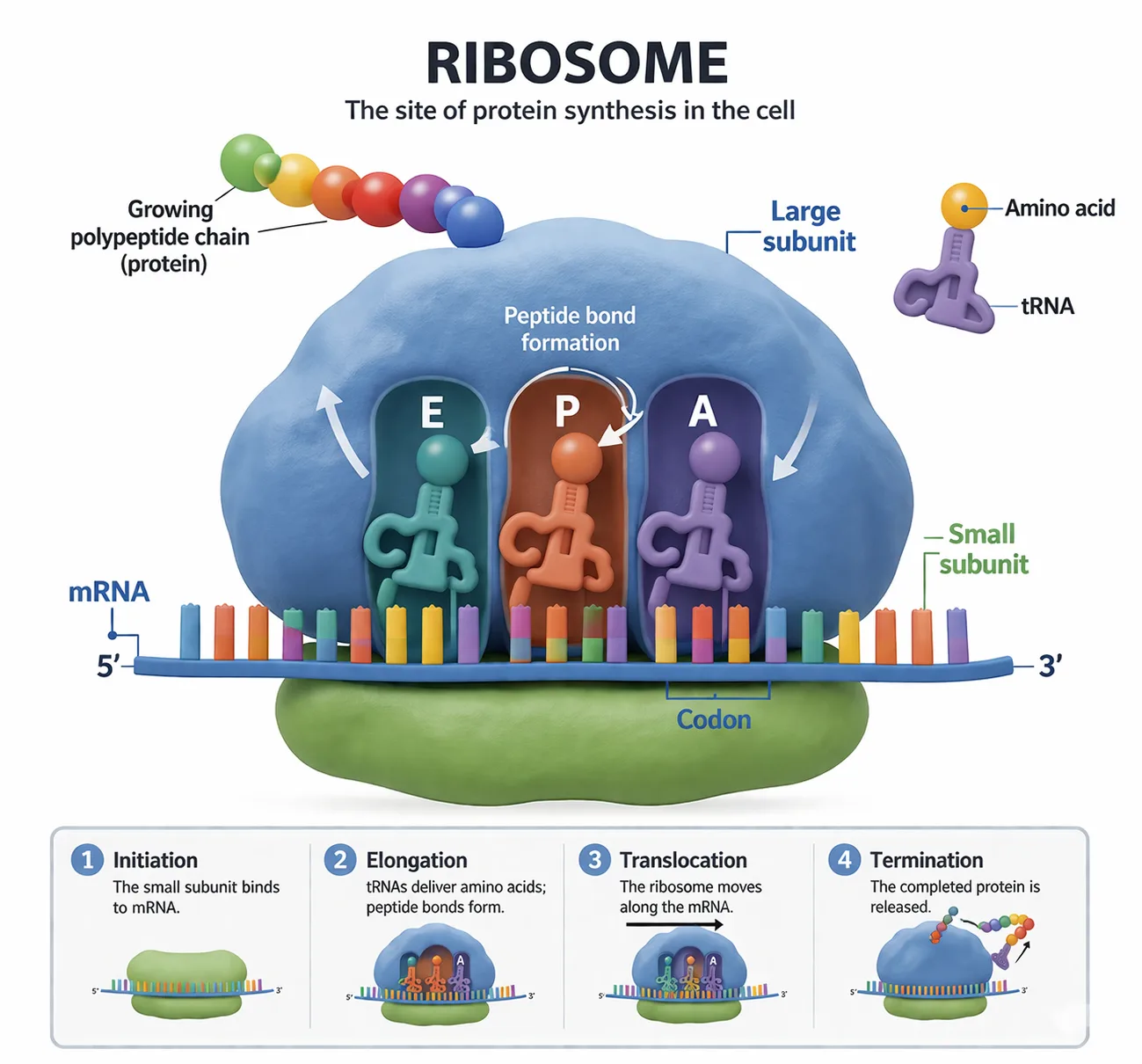
Prokaryotic ribosomes are relatively small in size, measuring about 15 nm by 20 nm. These ribosomes are 70S type and are found freely in the cytoplasm. Despite their small size, they play a crucial role in protein synthesis by translating genetic information into proteins necessary for the cell's functioning.
4. Prokaryotic ribosomes are made up of two subunits, namely _____
Correct Answer: B
Prokaryotic ribosomes are composed of two subunits: a larger 50S subunit and a smaller 30S subunit. Together, they form the 70S ribosome. These subunits work together during protein synthesis, where the 30S subunit helps in decoding the mRNA and the 50S subunit is involved in forming peptide bonds between amino acids.
5. The 50S and 30S ribosomal subunits together form _____
Correct Answer: B
In prokaryotic cells, ribosomes consist of two subunits: a large 50S subunit and a small 30S subunit. When these two subunits come together during protein synthesis, they form a functional 70S ribosome. The 'S' stands for Svedberg unit, which indicates the rate of sedimentation during centrifugation. The combined value is not a simple sum, but reflects the overall size and shape of the ribosome.
6. Ribosomes are the site of _____
Correct Answer: B
Ribosomes are the cellular structures responsible for protein synthesis. They read the genetic information carried by messenger RNA (mRNA) and assemble amino acids into polypeptide chains, which fold to form functional proteins. In prokaryotic cells, ribosomes are found freely in the cytoplasm and may also associate with the plasma membrane. Despite their small size, they play a vital role in cell function by producing proteins needed for growth, repair, and metabolism.
7. Several ribosomes attached to a single mRNA form a chain called _____
Correct Answer: B
When multiple ribosomes simultaneously attach to a single mRNA molecule, they form a structure known as a polyribosome or polysome. This arrangement allows the cell to synthesize multiple copies of a protein at the same time, making the process of protein production more efficient. Polysomes are commonly found in both prokaryotic and eukaryotic cells.
8. In a polysome, ribosomes help in _____
Correct Answer: B
A polysome or polyribosome is formed when multiple ribosomes attach to a single mRNA molecule. These ribosomes simultaneously translate the mRNA into protein chains. This process increases the efficiency of protein synthesis, allowing many copies of the same protein to be produced quickly within the cell.
9. Reserve material in prokaryotic cells is stored in the form of _____
Correct Answer: B
In prokaryotic cells, reserve materials such as nutrients are stored in the cytoplasm as inclusion bodies. These are not membrane-bound structures and may contain substances like glycogen, lipids, or phosphate reserves. Inclusion bodies help the cell store essential materials that can be used when needed for energy and growth.
10. Inclusion bodies in prokaryotic cells are _____
Correct Answer: C
Inclusion bodies in prokaryotic cells are storage structures that are not surrounded by any membrane. They lie freely in the cytoplasm and store reserve materials such as glycogen, lipids, and phosphate. Since prokaryotes lack membrane-bound organelles, these inclusion bodies remain free and directly accessible for cellular use.
11. Which of the following are examples of inclusion bodies in prokaryotic cells?
Correct Answer: B
Inclusion bodies are storage structures in prokaryotic cells that store reserve materials. They are not membrane-bound and lie freely in the cytoplasm. Common examples include phosphate granules, cyanophycean granules (which store nitrogen in cyanobacteria), and glycogen granules (which store energy). These help the cell survive during unfavorable conditions.
12. _____ are found in blue-green and purple and green photosynthetic bacteria.
Correct Answer: B
Gas vacuoles are specialized structures found in blue-green algae (cyanobacteria) and some photosynthetic bacteria such as purple and green bacteria. These structures help in buoyancy, allowing the organisms to float at optimal levels in water to receive maximum sunlight for photosynthesis. They are not membrane-bound and are filled with gas, helping the cells maintain their position in aquatic environments.