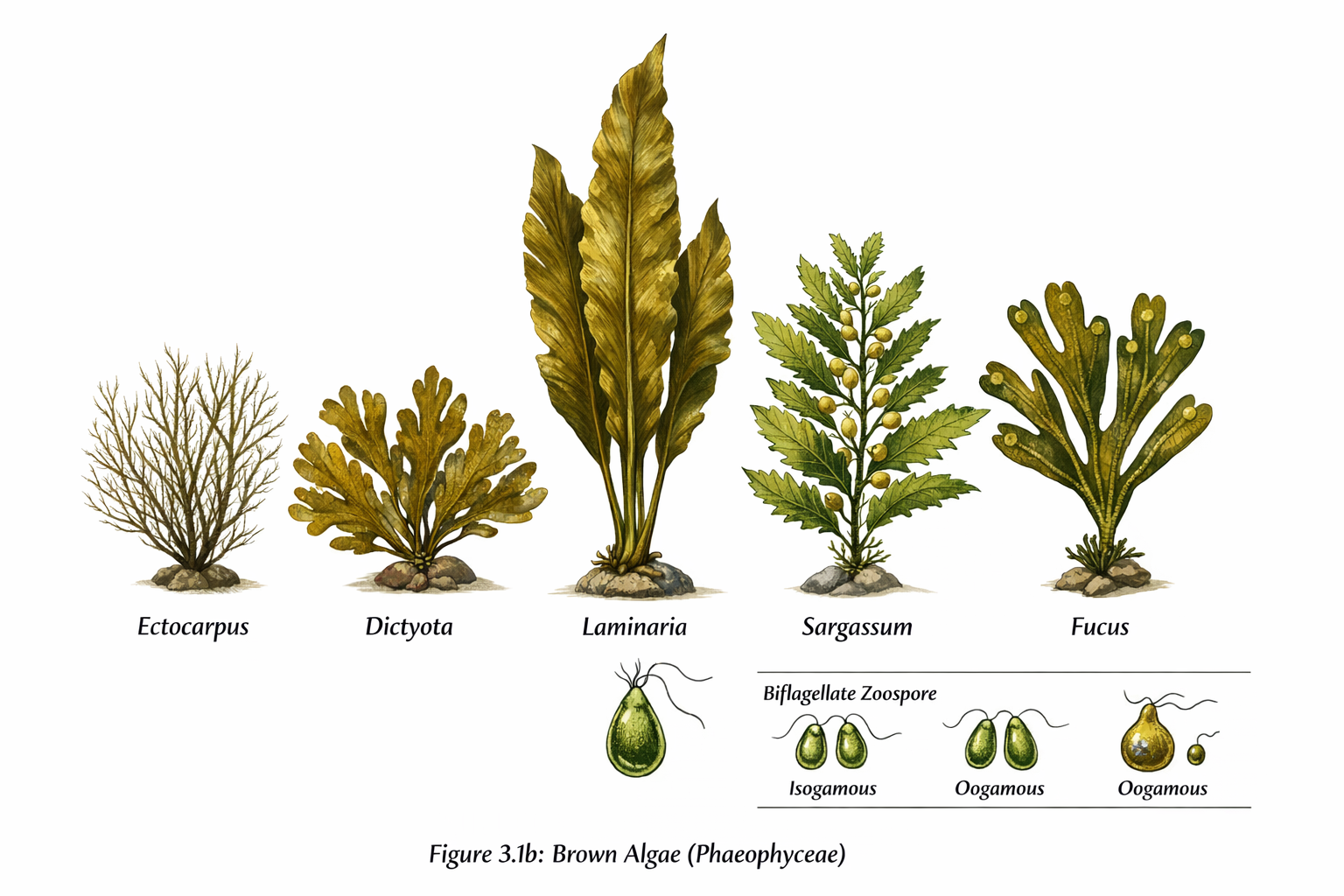
Phaeophyceae are commonly called brown algae due to the presence of the pigment fucoxanthin, which gives them a characteristic brown colour.
2. Phaeophyceae (brown algae) range from ______ to ______ forms.
Correct Answer: A
Brown algae (Phaeophyceae) show great variation in size and form. They range from simple branched filamentous forms like Ectocarpus to highly branched large forms like kelps, which can grow up to 100 metres in height.
3. Phaeophyceae contain which of the following pigments?
Correct Answer: B
Brown algae (Phaeophyceae) possess pigments such as chlorophyll a, chlorophyll c, carotenoids and xanthophylls. These pigments, especially fucoxanthin (a xanthophyll), give them their characteristic brown colour.
4. Phaeophyceae vary in colour depending upon the amount of the ______ pigment, ______ present in them.
Correct Answer: A
The colour variation in brown algae (Phaeophyceae) from olive green to dark brown is due to the presence of the xanthophyll pigment called fucoxanthin. The amount of fucoxanthin determines the intensity of the brown colour.
5. In Phaeophyceae, food is stored in the form of:
Correct Answer: C
Brown algae (Phaeophyceae) store food as complex carbohydrates such as laminarin and mannitol. These substances act as reserve food materials and are different from starch stored in green algae.
6. The term 'lamina' is derived from Latin meaning:
Correct Answer: B
The word 'lamina' comes from Latin, meaning a thin plate, sheet or layer. It is commonly used in biology to describe flat, leaf-like structures.
7. Laminarin is widely studied for its:
Correct Answer: C
Laminarin, a storage polysaccharide found in brown algae, is widely studied for its potential health benefits. These include anti-cancer, anti-inflammatory, antioxidant and anti-obesity effects, making it important in medical and pharmaceutical research.
8. The term 'mannitol' is derived from 'manna', which refers to:
Correct Answer: B
The word 'mannitol' comes from 'manna', a naturally occurring sweet substance obtained from plant exudates, especially from ash trees. Mannitol is a sugar alcohol and is used as a sweetener and in medicine.
9. Which of the following is a correct use of mannitol?
Correct Answer: B
Mannite / manna → a sweet substance (historically obtained from plant exudates, especially ash trees). Mannitol is a carbohydrate stored in brown algae. It is used as a low-calorie sweetener in sugar-free foods and chewing gum. In medicine, it acts as a diuretic and is used to reduce brain pressure. Thus, it has both biological and commercial importance.
10. In Phaeophyceae, the cell wall is made of cellulose and is externally covered by:
Correct Answer: B
In brown algae (Phaeophyceae), the vegetative cells have a cellulosic wall. This wall is usually covered externally by a gelatinous coating of algin, which helps in water retention and flexibility.
11. Algin (alginate) obtained from brown algae is mainly used as:
Correct Answer: B
Algin (alginate) is a hydrocolloid obtained from brown algae. It is widely used as a thickening and stabilizing agent in food products like ice creams, jellies and sauces. It is also used in medicine (wound dressing, dental materials), textiles, pharmaceuticals (drug delivery) and biotechnology (gel beads for immobilization).
12. Algin is commonly used in which of the following food products as thickening and stabilizing agent?
Correct Answer: A
Algin (alginate) is widely used in the food industry as a thickening and stabilizing agent. It is commonly found in products like ice creams, jellies and sauces where it helps improve texture and consistency.
13. In algal cells, the protoplast contains plastids along with:
Correct Answer: B
The protoplast of algal cells includes plastids along with a centrally located vacuole and nucleus. These components are essential for storage, metabolism and control of cellular activities.
14. Protoplast is defined as:
Correct Answer: B
Protoplast refers to the living part of a plant cell after removing the cell wall. It includes the plasma membrane, cytoplasm, nucleus and other organelles, but excludes the cell wall.
15. In brown algae, the plant body consists of holdfast, stipe and:
Correct Answer: B
In brown algae (Phaeophyceae), the plant body is differentiated into a holdfast (for attachment), a stipe (stalk) and a frond (leaf-like photosynthetic structure). These structures resemble parts of higher plants.
16. Vegetative reproduction in brown algae (Phaeophyceae) occurs by:
Correct Answer: C
In brown algae, vegetative reproduction commonly occurs by fragmentation. The plant body breaks into smaller pieces, and each fragment develops into a new individual.
17. Asexual reproduction in most brown algae occurs by ______ zoospores which are ______ and have ______.
Correct Answer: A
In most brown algae (Phaeophyceae), asexual reproduction occurs through biflagellate zoospores. These zoospores are pear-shaped and possess two unequal flagella attached laterally, which help in movement in water.
18. Sexual reproduction in brown algae (Phaeophyceae) may be:
Correct Answer: C
In brown algae, sexual reproduction shows variation. It may be isogamous (similar gametes), anisogamous (dissimilar gametes) or oogamous (large non-motile female and small motile male gamete), depending on the species.
19. In brown algae, union of gametes may occur:
Correct Answer: C
In brown algae, fertilization (union of gametes) can take place either externally in water or internally within the oogonium in oogamous species. This depends on the type of sexual reproduction exhibited.
20. In brown algae, gametes are ______ and possess ______.
Correct Answer: A
In brown algae (Phaeophyceae), the gametes are typically pyriform (pear-shaped) and have two unequal flagella attached laterally. These flagella help in movement during fertilization.
21. Which of the following are common examples of brown algae (Phaeophyceae)?
Correct Answer: A
Common examples of brown algae (Phaeophyceae) include Ectocarpus (filamentous), Dictyota, Laminaria (kelp), Sargassum and Fucus. These organisms show a wide range of size and structural complexity.